Thursday, January 14, 2021

Invincible Louisa, Newbery Winner 1934

 Do you know what this review represents? This is review number 99 out of... 99.

I

FINISHED

A

PROJECT!


More than six years ago I was stoked to reach number 50. But today... I don't know... in a few days the 100th Newbery winner will be announced and I will review it, then I will do the final round-up. I've been writing this blog for nine years, admittedly not very faithfully for a while. I'm well aware this blog is a personal project, pretty much just for me - but that somehow makes it even worse, and yet better, that I finished.

Without further ado...


Invincible Louisa, I'm so glad I didn't finish with a dud. Probably the best of the biographies that won Newberys - though I'd have to double-check. Before I read this book there was one other point that needed clearing up. Little Women. You just can't read a biography of Louisa May Alcott without having ever read Little Women. That's why this kept getting pushed. I just was certain that Little Women would absolutely not be my cup of tea. Whelp... I was incorrect. Little Women 5/5 stars - everyone that says it is a great classic is right.

Going straight from Little Women (759 pages) to Invincible Louisa (240 pages) is like reading an incredibly condensed and slightly twisted rewrite. Louisa based Little Women very heavily off her own life - especially herself and her sisters compared with the March sisters. Louisa certainly had to be invincible - her life was so fascinating! Anyone notice famous people run in packs? Louisa grew up around the likes of Thoreau and Emerson. Her father was very into the transcendentalist movement and was - in many ways - ahead of his time. Unfortunately that doesn't always translate very well into livable income. Louisa was often finding ways to help her family earn money and promised to one day find a way to give them all what they most desired.

Overall - an excellent biography (which I hope is mostly true) because then it is a historical fiction... This best parts are when you don't know what will happen because it veers so far from her fictionalized life as Jo March. All in all I'd recommend this easily to anyone but especially to fans of Little Women!

Wednesday, January 13, 2021

Waterless Mountain, Newbery Winner 1932


I think that the best way to describe this book might be the old adage: "The road to Hell is paved with good intentions."

We are playing fast and close to that line of writing about Native American cultures when you have very little to do with said culture. Two other winners that pop to mind are Island of the Blue Dolphins and Julie of the Wolves. I personally enjoyed those stories and researching them I can see that there are many issues - but they also get away with several things by virtue of being survival stories and not the stories of day to day living within the culture. Waterless Mountain doesn't have this factor going for it. My research indicated that, although the text says Navaho (the spelling used by Armer), several descriptions are actually Pueblo. I can in no way figure out what is what though and the online resources for a 1930s children's book that was out of print for decades are just not very thorough. 

What I really would like to say is that Laura Adams Armer seemed like she wanted to be respectful to Navajo people, and for the 1930s appeared to have done a good job. She comes off a little patronizing on a handful of occasions but she avoids both condescending stereotypes and the noble savage stereotype. Personally I'm stuck as to how to judge her on this area.

The area I'm not afraid to pass judgements is the story. It is pretty episodic, like many of these early Newbery Winners. But most of these episodes do nothing for me. I found the story to be pretty dry. It seems like the 30s just aren't my cup of tea. In a few weeks I plan to do a complete ranking of all the decades since the Newbery began - I'm guessing the 30s will either place dead last or second to last.

Thursday, December 24, 2020

Roller Skates, Newbery 1937


 This book was... okaaaaay... I've seen a few reviews from people that have read more of Ruth Sawyer's books and they seem to agree that this is not her best work. In this very episodic story 10 year old  Lucinda is left with some family friends in NYC while her parents spend a year in Italy. We are given a lovely setting filled with a variety of characters - perhaps too many characters. I liked all of them but none was quite fleshed out to their fullest potential because we had to bounce around between more than 20 side characters in a 200 page novel. And there were three lousy conclusions - I'm gonna drop what would be a major spoiler in any other novel - you've been warned....


A) One of Lucinda's many friends, an East Asian woman referred to by Lucinda as Princess Zayda is murdered

B) Tony and Luc- you're still thinking about point A aren't you?

Yep, murder. It is hinted that domestic abuse is involved but I'm not sure I'd have picked up on that subtext as a child reader. Lucinda begins visiting this woman frequently and once the woman's husband angrily comes home but seems relieved to find Lucinda instead of another man. Lucinda is so afraid she runs away. Over the novel Lucinda gives the woman English lessons and drops in to visit her frequently. After being dismissed early from school one day she decides to surprise her friend and goes to her apartment - where she discovers that she has been stabbed with a dagger that is still in her body! Lucinda quickly summons the landlord who says that it wouldn't do for Lucinda to be involved with the police so they will wait until the maid discovers the body and the whole thing is never really mentioned again??? I cannot fathom why this was put in the book only to be dismissed so completely. I saw a couple people mention that this book is loosely autobiographical... did... did little Ruth discover a murder victim?

Moving on.

B) Tony and Lucinda have the worst possible conclusion. Theirs is probably the strongest relationship in the book and it is so completely wasted at the end. (When hearing there was a sequel I was sure we were in for more Tony and Lucinda but.... guess not since the sequel is in Maine.) These two have been really happy and helpful friends throughout the book but they just kind of part without any good bye and that is partly due to....

C) The book just ends. I can see how the abrupt ending of Lucinda looking to the reservoir and asking her reflection if she'd like to always be 10 and stay forever in the park led Peter Sieruta, a blogger and book reviewer with far more credentials than I, to assume the book ended with her suicide. The book feels like the last several pages managed to get lost!

Monday, December 21, 2020

Gay-Neck: The Story of a Pigeon, Newbery Winner 1928

I had put this book off for so long because I very much expected not to like it. That is really the case with all three of my remaining Newberys. However I was so surprised! I loved this book and gave it the coveted five star rating on Goodreads - something I've gotten stingier with over time. I thought I'd check how the average user ranks it among the Newbery winners (of which there are 99 at time of writing)

98. Gay-Neck 3.30

99. Dobry 3.26


Many years ago I mentioned that I wasn't a horse girl. But as I was reading Gay-Neck I realized I was definitely a bird girl. I can take or leave horse books. Most cat books are not my thing. Dog books tend to be pretty good. But bird books? I'm racking my brain and I've never met a bird book I didn't like!

This novel is a great look at an upper caste life in late 1800s India, it is actually an own-voices novel which is not something I'd ever stumbled across for this particular time and place. Rudyard Kipling is one of my favorite writers - but I'll be the first to admit that his view is problematic when it comes to colonialism (imperialism?). Back to Dhan Gopal Mukerji, he immigrated to the US in his early 20s where he quickly became interested in many social movements and took to writing to support himself and his education. He became a very popular children's author - and in 1928 was awarded the Newbery. Apparently at the awards dinner he was seated in an inconspicuous place as the committee wanted the award to be a surprise; this was the first time an author of color won the Newbery and they were afraid his presence would be a giveaway before the announcement. Sadly, his fame may have contributed to anxiety and fatigue leading to Mukerji's suicide at the age of 46.

The plot of the book is two-fold. First it focuses on the raising and life in India of homing pigeons. The first-person narrator (perhaps loosely based on the author) raises pigeons in Calcutta, he introduces the text: "For a pigeon, life is a repetition of two incidents: namely a quest of food and avoidance of attacks by its enemies." Several times Gay-Neck is attacked and occasionally injured. After these attacks he must not only be physically healed but mentally, emotionally, perhaps even spiritually. On a couple occasions we are allowed to understand where Gay-Neck has been through his own first person narration.

At the mid-point of the book Gay-Neck is sent with a friend of the narrator to World War I in France. This book predates World War II so simply refers to 'a war in Europe'. The text manages to convey some horror of war while also maintaining itself as a text for children. Eventually Gay-Neck is released from the war suffering what we would come to refer to years later as PTSD. Through time and patience he is once again well enough to fly.

Mukerji leaves us with a text that emphasizes not only courage, but love and understanding. He used the story of a pigeon to illustrate the human condition - saying that fear is the root of our problems. He had been impacted and saddened by WWI, turmoil in his native India, and social struggles in the USA. The final line of the book offers his hope for the world - "Peace be unto all!"


As a side note the narrator is so moved by the sight of Everest at one point that he says, "O thou summit of sanctity, thou inviolate and eternal, may no man tarnish thee, nor may any mortal stain they purity even by his slightest touch. May thou remain forever unvanquished, O thou backbone of the universe, and measurement of immortality." I looked it up and was happy to find that Everest was not summited until 1953, several years after the author's death.

Sunday, November 15, 2020

Hitty: Her First Hundred Years, Newbery Winner 1930

 I've been saying that some of these older winners were in need of a re-write and this one actually has one!


I've got... notes. Let's start with the original text. First, congratulations to Rachel Field for being the first woman to win a Newbery. Although it took 8 years for the first it is pretty hard to accuse the committee of sexism when you consider that every winner from the 30s was written by a woman. Fields had a rather interesting life and many older readers of the Newberys list her among their favorite authors. I thought her writing was rather nice - I struggled with some of the dialects and vocabulary, but that is to be expected with a text this old. 
Most of the time the plot was interesting enough, but one can't help but notice certain things that would never fly in modern kids' lit. Yes, we've circled back round to racism. Though not as mean-spirited as the racism in Smoky it is still present. In the very beginning of the book Phoebe, one of Hitty's owners, is scared by some Native Americans while out picking berries,

"They were only some five or six squaws in moccasins, beads, and blankets, who had come after raspberries, too... I watched them filling their woven baskets and thought they looked very fat and kind, though rather brown and somewhat untidy as to hair" (Fields 20).

 After that paragraph the book continues on without incident for a while and I found myself thinking that, at least, it had been short and although cringeworthy not mean-spirited. Just wait. 

    The premise of the story is that Hitty, a carved wooden doll, is writing her memoirs when she is around one hundred years old. The story begins with her being carved in 1829 for Phoebe Preble, a young girl in Maine. This owner has the largest part of the text devoted to her, with 40% of the book being about her time belonging to Phoebe. Phoebe brings Hitty with her on a whaling ship captained by her father. When the crew mutinies and the ship catches fire the Prebles and a few loyal crew members are castaway on a South Pacific Island. This is when I had to give myself a little break from the book because, well, just read.

"Look they certainly did. I have never seen so many bright, black eyes in so many peering faces. I caught sight of nose rings and earrings under matted hair, of carved necklaces and bands of metal on wrists, arms, and ankles... 'They act like a parcel of children,' Captain Preble said, 'and I hope to glory they stay so.' Like children they easily tired of what had caught their attention, so next it was Phoebe about whom they began to crowd... and the biggest native with the most rings and beads on now caught sight of me between her fingers. He made a queer grunting noise at the rest and they all crowded about, pointing and gesticulating" (Fields 78-79).

Jeepers, if this doesn't illustrate a by-gone way of thinking about non-white culture that what ever could? How about the end of the chapter.

"At another grunt from him all the natives bowed their heads before me and went through more strange gesturings - and so I was carried away to become a heathen idol" (Fields 81). 

In the end she makes her way back to Phoebe in time for them to leave the island a join a ship sailing to India, however in India she is dropped by a sleeping Phoebe. After this beginning she bounces from one owner to the next every chapter or so. There are a few cultural missteps in the writing, Indians in great need of converting and the Southern US black dialect being the two I most noticed, but nothing ever approaches the uncomfortableness of the South Pacific chapters. A quick list of Hitty's owners:

  • Phoebe Preble - whaling captain's daughter
  • unnamed Indian snake-charming performer
  • Thankful - daughter of missionaries to India
  • Clarissa Pryce - Quaker girl in Philadelphia (took Hitty to listen to famous singer Adelina Patti, and also showed her to the poet John Whittier)
  • Milly Pinch - seamstress
  • Isabella Van Rensselaer - rich girl in New York City (met Charles Dickens who picked Hitty up)
  • Katie (Dooley?) - Irish girl from Rhode Island who takes Hitty to Kansas when she goes West to regain her health
  • Mr. Farley - traveling artist 
  • Miss Hortense and Miss Annette - loaned to by Mr. Farley to use as a dress model for cotton exposition
  • Sally Loomis - daughter of a Mississippi river boat captain
  • Caroline - girl living on a southern plantation along the Mississippi River
  • Charlie - postman that buys Hitty's box from the dead-letter office - immediately loses her
  • Jim's wife - uses Hitty to practice making a pincushion with a doll body
  • Louella - receives Hitty pincushion for birthday
  • Miss Pamela - doll collector
  • Old Lady - antique collector that happens to live in the Preble's old house in Maine
  • Old Gentleman - owner of antique shop in New York City
Overall a decent read, though I preferred the same concept done recently with The Miraculous Journey of Edward Tulane by Katie DiCamillo. Sometimes the writing style in this one just really slowed things down - and this from someone who reads a fair amount of older books. It could also be that I was never really a 'doll girl'.

Okay - now the rewrite, adaptation, homage, whatever you want to call it.

Rosemary Wells, of Max and Ruby fame, explains that Hitty was one of her favorite books growing up. She was asked by Susan Jeffers, another fan of the book to shorten the text for an illustrated storybook she wanted to do. While Wells initially didn't want to she found that many libraries hadn't circulated the book very much in decades. So here we are. 
I always flop back and forth on the subject of abridgment. But I think it can be done well - Wells strips the beginning of its more problematic views on other cultures and tosses outdated vocabulary out in favor of more recognizable words. Abridging can also cause problems- also lost is the conflict on the whaling ship, a great many descriptive passages, and a better sense of 100 years, but most egregious is when Wells didn't just adapt the story - she straight up rewrote it. 
Adapting changes the story all the time - but generally it does it within the change of a medium. Movies are often different than their books - but as a different medium it can sometimes be necessary - at any rate you are now targeting a different audience. This is a book adaptation of a book that is only half the original book. And I don't really know why.
Notes on the aforementioned racism - the Native Americans at the beginning of the story now are now described in one sentence, "Only Penobscot women knew about this berry patch and picked there." Wow... somehow even shorter than the original's few pages - but non-offensive I guess. For some reason the tribe has been changed from Passamaquoddy to Penobscot. The South Pacific Islanders also fair better, the Preble's still do not understand what is going on, but Hitty is taken not as a god but as a gift for the chief's son. She isn't viewed by worshippers but by friends of the boy.
There also exists in this book a small necklace with an elephant on it that Hitty is made by Captain Preble. Why? 


So let's run down the list of owners - I assure you it takes a turn. 

  • Phoebe Preble
  • unnamed Indian snake-charming performer
  • Thankful
  • Clarissa Pryce - who takes her to see Abraham Lincoln (?????)
  • Sergeant Jim Chapelle - a Confederate soldier tasked with going through mail, she becomes a post office mascot
  • Mary Chestnut - encourages her seamstress, Millie Nettletree, make a dress for Hitty to wear to the Cotton Expo and win a prize to send Millie's granddaughter to school
  • Sally Loomis
  • Caroline
  • Mr. Copley - traveling artist that takes Hitty with him to paint a portrait of the Roosevelt children
  • Rebecca Solomon - young art admirer that is homeschooled because she uses a wheelchair
  • Mr. D'Ardsley - owner of New York City Antique/ Pawn shop
  • Parthenia Nettletree - granddaughter of Millie who indeed went to school, in process of paying for Hitty as the book ends
Some of the streamlining I get... but not other bits. Halfway through adapting the story Rosemary Wells begins writing a brand-new story using Field's original characters. It's good, but it seems very unnecessary and if I were a bigger fan of the original I'd probably be more angry. 

Overall, I wish the rewrite had stuck to the second half more faithfully and then I could easily recommend it. As it is, it is a good story - but not the one the author originally conceived. 

The Grey King, Newbery Winner 1976

 The Grey King is the fourth book in the series sequence The Dark Is Rising by Susan Cooper. It falls back into the good old-fashioned fantasy story. Unlike The Prydain Chronicles, I believe each book stands on its own slightly better, but in order to be their best should still be read as a series. From the beginning!


Over Sea, Under Stone (1965)

I really liked this one. As I went through the series I kept comparing them to this first book which is so entirely different from the rest of the series that it really isn't a fair comparison. This book has shades of Narnia (which is my jam) - a group of siblings, England, mythology, and a quest. The siblings in question are Simon, Jane, and Barney Drew - they are spending their holidays on the coast of Cornwall in a house rented by their family friend Merriman Lyon (they often refer to him as their Great-Uncle, though the book is adamant that they are unrelated). They find a map that leads them to a mysterious grail, but they have to stay one step ahead of shady characters every step of the way. Although the sequence as a whole is fantasy this one falls more into contemporary literature/ mystery with a few fantasy elements. 

When read on it's own it stands fairly well but you get the feeling that it is part of a larger series. However, I can't confirm if this was always the intention since the next book is a different tone, with different characters (save Merriman), and was published 8 years later!

The Dark Is Rising (Newbery Honor 1973)

Yes, the second book shares its name with the entire series. The book introduces the main hero Will Stanton and cements the overarching themes and plot for the series. It is consistently found on lists of 'Best' Books - be it best books for children, best Newbery books, best books for the classroom, etc... Of course all this means that I thought the book was - okay. I preferred the slightly lighter fare of Over Sea, Under Stone and really missed the Drew siblings. Will doesn't really have anyone to work off a lot of the time and when he does it is almost always adults (in spite of the large number of siblings available).
Will, the seventh son of a seventh son, discovers on his 11th birthday that he is the last of the Old Ones, a group of immortals who are tasked with being guardians of 'the Light'. He begins a quest to gather six signs together and temporarily drive back 'the Dark'. I just don't understand how this book is so popular and loved when virtually every other book in the series is better.

Greenwitch (1974)

This book is the shortest and many don't seem to care for it much. It brings the Drew siblings back (yay!) and has them join Merriman and Will (meh) to try to find the grail (again). Will has been trained enough at this point that he should be able to translate the mysterious markings on the grail and reveal its secrets. Jane is the only child in this volume that doesn't act like a total nincompoop throughout. Anyway she sees the creation of the Greenwitch and her natural instinct towards compassion and empathy is what in fact ends up saving the day.

The Grey King (Newbery Winner 1975)

Finally! This is the book that made Will Stanton interesting enough to carry a book, all it took was him having other people to work off of without being a nincompoop. This book won two awards the Newbery (best contribution to American children's literature) and the Tir na n-Og Award (best children's book with an authentic Welsh background. Yes, dear reader, our fantasy is headed back to Wales! Will is sent to his aunt in Wales to recover after a long illness, he befriends a local boy named Bran and involves him in his newest mission from Merriman. This book really ramps up the Arthurian influence which always makes for good fantasy. I can definitely see why this book (or even the next) would be winning books. I think this book would stand just fine on its own, though you'd feel a touch unfulfilled at the end. This book accomplishes two things: It makes me want to visit Wales and it makes me want to traditional classic Welsh mythology.

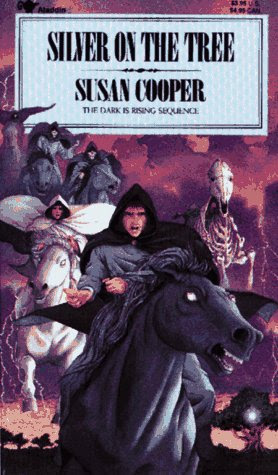
Silver on the Tree (1977)

This is the epic crossover event where all of our characters are brought together and so many plots are finally wrapped up. My only wish is that the Drew siblings had more to do in this volume. One of the things I liked most about Greenwitch was that it was just Jane being herself and being kind that saved the day. This shows just how much power ordinary people (even children) hold against the Dark. However, I am totally sold on the conclusion and would hate to spoil certain aspects, but something I really like is the fact that there are actual consequences, there are difficult choices, and there is a train. How many fantasy epics end with a train ride?

Overall I'd recommend this series to fans of Arthurian legends, the British Isles, children's books, or fantasy series. It was not my favorite series but it was serviceable and remains highly popular half a century after its initial publications.

Saturday, November 14, 2020

A Single Shard, Newbery Winner 2002


Linda Sue Park is a celebrated author that often incorporates her Korean heritage into her books she has written six novels in the last two decades and this... I the only one I've read. I really enjoyed this story and if I could draw a quick comparison it reminded me of a Studio Ghibli film. Not the content or character - but the pacing. It is not super plot driven, and the characters, though nice, aren't strong enough to be a massive driving force in the plot. This a just a slice of Tree-Ear's life that was particularly important to his life's journey.

Tree-Ear is an orphan in 12th century Korea living with his caretaker Crane-Man near a potters' settlement. He often observes one potter working and wishes to become his apprentice. When he begins doing chores to pay off a debt he finds himself learning more and more but feeling frustrated that he isn't being instructed how to make truly amazing items. Though the eventual conclusion of this novel went pretty much exactly how one would imagine it took some interesting paths to get there.

Once again I found it helpful to have Google handy while reading. I know very little about modern Korea and even less about olden Korea. The special pottery talked about in the book is celadon - in fact the book was inspired by a specific piece hailed as one of the finest examples of Korean artistry. Overall, I would greatly encourage anyone to read this book.