Saturday, July 25, 2020

The Ninth Round-up


I'm giddy you guys. I have follow through issues on long term projects. Yet here I am 90 books in!

Our latest batch included a couple rereads for school, a couple sleeper hits, and some big disappointments.

1. ...And Now, Miguel - I absolutely adored this book. I consider this one of the Newbery must-reads and also what I'd currently call the most under-appreciated Newbery.

2. The High King - A great conclusion to a series, but a pretty poor stand-alone. If you like high fantasy the Chronicles of Prydain are must-reads.

3. Carry on Mr. Bowditch - Surprisingly enjoyable - for me. I struggle to see that it has much kid appeal though, much like that book from long ago Call It Courage.

4. I, Juan de Pareja  - I enjoyed Juan's joy in art and his defiance of the law to become a painter in his own right. Not everyone has the strength to stand in open protest, but what he did was important and brought him and many others happiness.

5. A Year Down Yonder - A quirky little read that brings us through a year in s small Midwest town shortly after the Great Depression.

6. The Higher Power of Lucky- A fairly nice, if mostly unmemorable examination of family and belonging. The most noteworthy contribution to the set-up in the setting. A small Southwest desert town provides a good backdrop for this tale.

7. The Witch of Blackbird Pond - I guess I read this one in school, but I certainly enjoyed it more now.

8. Walk Two Moons - The good parts were really good and it interwove a nice story. But for me it was bogged down with some issues concerning the use of Native American imagery.

9. Lincoln - A book that, in my mind, treaded a well-worn path. It examined a well-examined subject and brought nothing new to the table.

10. Smoky, the Cowhorse - I'm not sure I even need to reiterate that this story had some real problems concerning race. Yikes.Yikes.Yikes.

Alright, the countdown!!!


  1. A Wrinkle in Time
  2. Number the Stars
  3. Crispin: Cross of Lead
  4. Island of the Blue Dolphins
  5. Julie of the Wolves
  6. Maniac Magee
  7. Bud, Not Buddy
  8. King of the Wind
  9. The Trumpeter of Krakow
  10. Out of the Dust
  11. When You Reach Me
  12. Crossover
  13. Merci Suárez Changes Gears
  14. ...And Now, Miguel
  15. The Tale of Despereaux
  16. The Door in the Wall
  17. Holes
  18. Caddie Woodlawn
  19. Kira-Kira
  20. Sounder
  21. Good Masters! Sweet Ladies!: Voices from a Medieval Village
  22. The Giver
  23. The High King
  24. The Westing Game
  25. Bridge to Terabithia 
  26. Roll of Thunder, Hear My Cry
  27. The View from Saturday
  28. Sarah, Plain and Tall
  29. Joyful Noise: Poems for Two Voices
  30. Call It Courage
  31. Miracles on Maple Hill
  32. Moon Over Manifest
  33. Carry On Mr. Bowditch
  34. The Wheel on the School
  35. The Cat Who Went to Heaven
  36. The One and Only Ivan
  37. The Midwife's Apprentice
  38. Mrs. Frisby and the Rats of NIMH
  39. The Twenty-One Balloons
  40. The Hero and the Crown
  41. Onion John
  42. Shiloh
  43. The Graveyard Book
  44. New Kid
  45. Adam of the Road
  46. The Girl Who Drank the Moon
  47. Hello, Universe
  48. The Summer of the Swans
  49. I, Juan de Pareja
  50. Dear Mr. Henshaw
  51. Missing May
  52. Dead End in Norvelt
  53. Tales from Silver Lands
  54. A Year Down Yonder
  55. The Higher Power of Lucky
  56. Last Stop on Market Street
  57. Voyages of Doctor Dolittle
  58. The Witch of Blackbird Pond
  59. Jacob Have I Loved
  60. A Gathering of Days
  61. The Whipping Boy
  62. The Slave Dancer
  63. Dicey's Song
  64. Walk Two Moons
  65. Shen of the Sea
  66. Shadow of a Bull
  67. The White Stag
  68. Rabbit Hill
  69. Strawberry Girl
  70. Flora and Ulysses
  71. Miss Hickory
  72. The Matchlock Gun
  73. A Visit to William Blake's Inn
  74. Thimble Summer
  75. Lincoln, a Photobiography
  76. M.C. Higgins, the Great
  77. Young Fu of the Upper Yangtze
  78. It's Like This, Cat
  79. Ginger Pye
  80. The Secret of the Andes
  81. Criss Cross
  82. Up a Road Slowly
  83. The Dark Frigate
  84. Rifles for Watie
  85. Amos Fortune, Free Man
  86. The Story of Mankind
  87. Johnny Tremain
  88. Dobry
  89. Daniel Boone
  90. Smoky, the Cowhorse
It finally happened, Daniel Boone had been at the bottom since the second round-up. I was beginning to think it would never be unseated as the worst Newbery, but Smoky managed to pull through with overt racism and a long-drawn out middle. At least Daniel Boone was short.

Friday, July 24, 2020

Lincoln: A Photobiography, Newbery Winner 1987


Guys. How do I even review something like this? It is exactly what it says on the cover. It's a Lincoln biography, and I can't even really say that it brings anything new to the table...

Nope, even the Wikipedia page didn't give me much. Is it well written? Yes. Is the subject interesting? Yes. Is it suitable for young audiences? Yes.

But this is Lincoln the most often written about person in USA history! I'm not sure anything new remains to be brought to the table - we already even have him starring in a book as a vampire hunter!

Whatever. Decent book - but I'm unable to comprehend its rise to power.


GUYS.
GUYS.

This book beat Hatchet. Let that one sink in....

Carry on Mr. Bowditch, Newbery Winner 1956


A fictionalized biography. This is the one I knew the least about going into, because I still have never seen a physical copy of this book! I listened to some lady on Youtube read this one and honestly, it was pretty decent. I can't imagine how the publisher hoped to suck in the young 'uns - but for someone with my nerdy tastes this book was pretty good.

Mr. Bowditch was a naturally gifted mathematician who was unable to fulfill his childhood dream of attending Harvard due to his father setting him up in an apprenticeship during hard times.
However, he didn't let this stand in the way of learning - I dare say he doubled down. He taught himself calculus... after first teaching himself Latin so he could read the calculus book. And then he learned French, Spanish, Portuguese... basically any language he fancied.

Being super skilled and familiar with ships thanks to his family and apprenticeship, he joined a crew as a ship's clerk. Being nerdy he also took navigational readings, taught the crew how to navigate, and invented a new method of navigation that worked without clear skies... as one does. He found so many errors in a book he was asked to check he decided to just up and write his own. He was so accurate that the Navy bought its copyright 65 years after it was first published!

In all this was a great book for nerds like me - but I'm not sure it has much kid appeal outside of a niche group that likes reading about guys that really, really love math.


Friday, July 17, 2020

The High King, Newbery Winner 1969... eventually

I was very, very deliberate about this book. The High King is the final book in the quintet of books called The Chronicles of Prydain; I made sure to read all five books, which is probably lucky because I don't think The High King would work very well as a stand-alone. Unfortunately for this reason I'm not really sure if it deserved the Newbery Medal, however - if we were to take the Medal as a sort of award for the series as a whole I totally get it. The Chronicles of Prydain is excellent, very reminiscent of Lewis or Tolkien's work and deserving of a place amongst the greats for high fantasy. So it all depends on how the committee was treating the award at that point in time. Let's start at the very beginning....


The Book of Three (1964)
A great introduction to this fantasy world. I listened to the audio the second time round and it helped immensely because of all the names heavily inspired by Welsh. Though this story stands decently on its own story wise, it is definitely the set up for a larger tale but there is no sense that you're left hanging at the end. I read this for the first time many years ago and was satisfied even without finishing the series.
The primary purpose of this first book is to establish our primary characters:
Taran is a dreamer that wants more. His mysterious past means and high aspirations make him an easy target for maincharacteritis.
Princess Eilonwy is NOT your typical fantasy damsel. She tap dances on just this side of annoying, but in the end I appreciate Lloyd writing a fleshed-out female character in this genre in the 60s - and her flaws kind of make her more impressive.
Fflewddur Fflam is a wandering bard/ king. I really loved his character. His harp is magic and the strings snap whenever he lies, er - colors the truth. A great set-up that manages not to get old even five books in.
Gurgi.

If you ever saw the Disney movie you might be a tad inclined to hate Gurgi. Thankfully he is faaaaaaaaar less annoying in the books! A wild man-beast he talks nonsensical phrases but often proves himself quite helpful. He starts out very cowardly and develops throughout the series into a brave companion.
Doli is a dwarf who constantly acts harsh and grumpy, but is really quite pleasant deep down. At the end of this first book he gains the power to turn invisible.

There are some other characters but really our five-man-band are the important ones.
The most significant plot point is a sword Eilonwy steals from a dead king (though she wouldn't consider it stealing). Taran wants to use the sword on a few occasions but she refuses to let him because, 'only a true king may wield it'. This immediately sets of your mysterious origins alarm bells, but in the end Taran is NOT able to wield the sword without being grievously injured. Prince Gwdion turns out to be able to use the blade. The end of the story sees everyone returning home (except Eilonwy she follows Taran seeing as her old place is a pile of rubble) and a delightful reset of the status quo.


The Black Cauldron (Newbery Honor 1966)
The classic fantasy archetype. The heroes are trying to find and/ or destroy some object - in this case the Black Cauldron. Our main five join the quest of Prince Gwydion in order to find the Black Cauldron before the bad guy (we have enough names here). The sacrifices in this book are so much better and more heartbreaking than the film.


The Castle of Llyr (1966)
My least favorite of the series. During a reread I'd even be tempted to skip it (I do that with a book in both Narnia and Harry Potter as well). In this story we are introduced to the thoroughly incompetent Prince Rhun, an arranged suitor for Princess Eilonwy. Eilonwy is kidnapped by some of those Welsh-named villains (I had trouble keeping them all separate) so Rhun joins the usual Taran, Gurgi, and Fflewddur Fflam. Rhun is another character that dances perilously close to unlike-ably irritating, however he does seem to realize what a goof-up he can be and works to improve himself. We also pick up Kaw (a talking raven) that proves very helpful and endears itself to Taran and Llyan (a magically giant mountain cat) that eventually becomes the familiar of Fflewddur Fflam.


Taran the Wanderer (1967)
Definitely the sleeper hit from the series. This one seems like a throw-away character study. But Taran's personal quest to discover his origins adds the character development that Taran needed. His growth has been occurring all through the series but here it is on full display. I adored his personal journey and how we see how he is when not on a quest for the princes or kings of the various lands. This book more than others follows an episodic nature - and makes for a really nice change of pace.


The High King (Newbery Winner 1969)
And now the main event! A true conclusion to an epic fantasy means one thing.


 War

The Welsh-named villains whose names seem to all start with A have gathered an army and stolen the super important sword from Prince Gwydion. Everyone agrees the sword is the only weapon capable of defeating our primary big bad. People and plot lines from all the previous books wind together to an epic final showdown. I hate to spoil things - let's just say payoffs to mysterious origins occur, deaths are unexpectedly devastating and difficult choices are made. I was so pleased with the end of this series.

Darn this movie for making me avoid this series. Darn it, darn it, darn it.

Overall a series I highly recommend from an author whose characters are all enjoyable despite (and in some cases because of) their flaws. Lloyd Alexander clearly was a master of his craft and his obvious love of Wales and Welsh mythology and history shine through in these works.

Thursday, July 16, 2020

...And Now Miguel, Newbery Winner 1954


Joseph Krumgold is one of the six dual winners of the Newbery Medal - the first in fact! Although I reviewed his novel Onion John many years ago, ...And Now Miguel was actually his first winner.

Confession - I avoided this book for quite awhile (that's actually the case with most of the remaining books), you see - the beginning of Onion John was SUCH a chore. But remember I said that the father-son relationship blossomed into something amazing right as the book was finishing? That was the entire book this time! I loved how this book examined relationships, responsibilities, and growing up. My older copy said it was destined to be one of the great American novels, I'm sad that it doesn't appear to be more popular.

This book has an interesting backstory - it's kind of a biography. Krumgold did lots of work in Hollywood and was asked by the U.S. Department of State to create a film about Hispanic-American rural life. This docu-film (documentaries back then often played fast and loose with the facts) was 'And Now Miguel', he later adapted the film into this book. Which was later adapted into a film...

Is it an adaptation circle... or an adaptation triangle?

Anyhow, the Chavez family were very real and were in fact sheep ranchers. Krumgold must have spent quite some time with them because the utter realism of the book is so comforting. I think that the realism of family life has rarely been so well conveyed in a book.

Miguel Chavez is a twelve year old boy in a family of sheep ranchers. Every year his father, uncles, and two older brothers take the family's sheep up into the mountains for the summer. Miguel is really eager to join them this year and sets about trying to prove how responsible he is so that his father will allow him to come. Unfortunately, it seems like his hard work may not be enough, so he asks St. Isidore for help.

I feel to tell more would spoil just how good of a book this is. Certainly the minority depictions in this book are are breath of fresh air after my last two reads- particularly Smoky. *shudder*
Let's just list what makes this book amazing:
*Rural life depiction
*Solid father-son relationship
*Catholic depiction that doesn't dive into fantasy
*Excellent discussion about not getting things for free - you need to put something into it to get what you desire
Humankind cannot gain anything without first giving something in return. To obtain, something of equal value must be lost.

*Natural consequences - both good and bad
*Siblings being friends but also mentors
*Amazing family values, "We didn't just get lucky (finding a responsible hand). We raised him."

In closing:

READ THIS BOOK!

Saturday, July 4, 2020

Walk Two Moons, Newbery Winner 1995


This is one of those books that everyone seems shocked to hear I haven't read, yet I don't recall ever thinking about it until I started on the Newbery quest.
I like most of this book. It has that intertwining story idea that I love. It has a nice road trip element to it. There is some interesting social commentary. It even manages to deliver a couple of good twists.

However there were some elements that rubbed me the wrong way. There is a lot of Native American imagery portrayed in a very generic way. As though Native Americans from Kentucky to Idaho were all just one homogenous group. I'm not versed enough to know what each region's tribes are like - but I do know they are varied.

There are other things - Salamanca's name being a misheard or misremembered version of Seneca, the tribe her mother supposedly belongs to and is proud of. (For a better breakdown see this post on AICL.) Sal's Grandmother dons a headdress and somehow ends up in the middle of a tribal dance. 😳
Of course there's also the title...

I like the general message of the book, but some of these issues could be cleaned up.

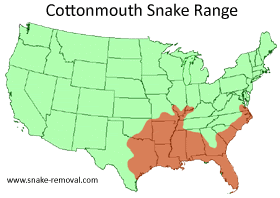
My next issue is a nitpick. Sal and her grandparents stop at the Missouri River in South Dakota. Sal's grandmother gets bit by a snake which she refers to as a cottonmouth. Either she's wrong or the author is. Since no one ever clarifies the grandmother's mistake (including a local boy and hospital staff) I'm forced to assume that Creech just used a venomous snake she knew liked water.

No where near South Dakota...

After a day in the hospital (1 day?!?) they are back on their way to Idaho with grandmother sliding continuously downhill. STOP AT A HOSPITAL!!!

The best part of this book is undeniably the message. Grief is something that hits everyone in different ways, we all need to face it, and it can introduce new things and people into our lives. Grief is strongest for those we've loved - but the flip side of a life with no great loves is even sadder.

I liked the realistic setting and style (Phoebe's story was every bit as believable and important as Sal's.) I know I've read some of Creech's other work and I'd be interested in how it compares.

Monday, June 29, 2020

Smoky the Cowhorse, Newbery Winner 1927


It's official - just because Marguerite Henry can write a Newbery winning horse book that becomes one of my favorites doesn't mean everyone can. I'm saying it right now - unless you're reading all the Newbery books I do not recommend this book and I especially do not recommend for children.
Where to start?

The book starts off nice enough - if slow. We follow the adventures of young Smoky in the mountains  - presumably the Rocky Mountains (Wyoming was mentioned but I'm not sure if that was where the Rocking R lands were or not). Anyhow happy horsey antics make up the first 80 pages. Like I said this part was nice - if we just had the life of a wild horse for 200 or so pages it would have been a  solid enough story. Heavy on the dialect, and poeticism - but solid.

Now - the middle piece. Uggggggh. The next 120 pages could have been condensed sooooooo much. Basically it is how Clint, a bronc buster, broke Smoky and became his rider. Smoky only liked Clint and he was a mighty fine horse. They ride the range for a few years until Smoky attains legendary status. It took me for-ev-er to get through this part. In the end I bought the Kindle book and used some fancy feature I've never needed before that drug the words across the screen, meaning I had to keep going or get lost. This chunk of the book contained important set-up but very little in the way of interesting plot.

So by this point in the book you would honestly have been better off choosing almost any other horse book that I'm familiar with and probably a fair number that I'm not familiar with. If you want the story of the West from the horse's mouth there's also this old animated movie - which I dug, it gives you a pretty similar plot sans the ending.


Alright, there are 120 pages left. What could they possibly bring us? Well, two things really: the plot and... racism.

Let's be honest the Newbery - and children's literature in general is no stranger to racism. It pops up all the time in things this old. The scale also ranges dramatically - not that it is ever right, but some offenses are definitely more egregious than others. I have read almost 90% of the Newbery winners now and this one was the one that made me think less, "Wow, this was written in a different era." and more, "Yikes."

This is gonna take an entire post in the future, but for now here are some choice quotes from the book - a book marketed to Ages 8-12 according to my copy printed in 2008 or later.

"All of him, from the toe of his gunny sack covered boots to the dark face which showed under the wore out black hat, pointed out as the man being a half-breed of Mexican and other blood that's darker, and noticing the cheap, wore-out saddle, the ragged saddle-blanket on a horse that should of had some chance to feed instead of being tied up, showed that he was a halfbreed from the bad side, not caring, and with no pride." (219-20)

We get many more instances referring to "his kind", "half-breed", and "the breed".

"There was all about the horse to show that he'd been right in his first dislike for the dark faced hombre." (240)

"But there was one thing which the riders noticed in him as most queer, and that was in the way he seemed to hate some humans worse than others - his hate was plainest for the face that showed dark." (251)

"'Say, cowboy,' (the sheriff) finally says, 'don't scatter that hombre's remains too much, you know we got keep record of that kind the same as if it was a white man, and I don't want to be looking all over the streets to find out who he was.'" (315)

Can anyone in good faith give this to an 8 year old? I hope not. Again, I've got a dedicated post planned, but it's going to require some planning and research.

For the record Will James was surprised he won the Newbery since Smoky was published for adults... my future blog plans include comparing the Newbery winners to honors and choosing the book I believe was the best. The honor books for 1927 are - lost to time or never existed. Was this adult book really the best for the year???
Some internet sleuthing later...

I turned up two other contenders on Wikipedia (my sleuthing isn't very comprehensive today) - Doctor Dolittle's Caravan by Hugh Lofting and The Hungry Tiger of Oz by Ruth Plumly Thompson. I haven't read either of these yet, but I can imagine the Lofting would have taken the prize had it not been for the tiny detail that he'd won four years previous. If anyone can name a 1926 American children's book that deserved the win let me in on the secret please!