Tuesday, February 5, 2019

The Complete 2017 Newbery Read-Through

Well, it's been a looooong time coming. After all, I'd read three out of four of these before the award was ever announced (and that missing book took me less than thirty minutes to read). But I'm the worst kind of procrastinator in that once I get behind I tend to just get more and more behind. Hopefully I'm well on my way to getting back on track.


Freedom Over Me: Eleven Slaves, Their Lives and Dreams Brought to Life by Ashley Bryan is a picture book, but I do believe that the writing holds its own and can stand without its illustrations. Ashley Bryan found the names of eleven slaves on an auction list in some of his historic documents. Using this list that contained names and prices (also I believe gender and rough age) he tried to envision each of the eleven people listed. He writes a poem about each person and their dreams and creates a portrait - we not only see who they are but who they wish to be. Of course his description is more likely than not to contain inaccuracies - but it puts a personal face to the tragedy of slavery that stripped so many of their identities and prevented them from realizing their dreams.


The Inquisitor's Tale by Adam Gidwitz is the book I predicted would take the win. I initially went in with quite a bit of trepidation - I was wary of how Catholicism might be portrayed in a book with 'Inquisitor' in the title. I still am not sure how to feel - the story was enjoyable and I don't think the Church as a whole was portrayed negatively. But there were so many inaccuracies on technical things that sort of played into a fantasy aspect. As an adult I found it quite enjoyable, as a Catholic child I might have felt confused and occasionally insulted. Overall, a book that I don't feel was purposefully trying to be harmful or malicious, but was from the perspective that really mixed faith and fantasy quite a bit.


Wolf Hollow by Lauren Wolf definitely leans towards the older end of the Newbery age focus. It has been compared to To Kill a Mockingbird by many reviewers. It would would probably be best classified as young adult rather than children's literature because it is quite dark. The main character Annabelle finds herself bullied by a classmate relentlessly. The bullying escalates and begins to physically harm the people in Annabelle's life. Toby, a veteran from WWI, begins to draw the towns suspicions and Annabelle's efforts to stand up for him seem to fall short. In the end whose word will prevail, Annabelle or her bully, Betty? Bring your tissues and make sure that you pre-read this book before deciding if it is right for the children in your life.

And now the winner....

The Girl Who Drank the Moon by Kelly Barnhill - Another hard fantasy! I thoroughly enjoyed this fantasy and really liked how all the material came together. Starting at the beginning we have a woman that is a witch and takes a child from the village in the woods each year. This is a classic fairy tale set-up, but then we are offered the events from the witch's point of view. Xan saves this child - feeds it starlight and carries it through the forest to a family waiting for it.
One year however she feeds the abandoned girl moonlight - a meal that imbues the baby girl with powerful magic. Xan names the girl Luna and raises her in an isolated swamp as her granddaughter. Other residents of the swamp include a tiny dragon who wishes to be bigger and a swamp monster.
Back in the city Luna's mother is locked away as a madwoman, the coming heir struggles with the traditions of his city, and the council keep secrets.
One year they all come colliding together in a grand climax that is precisely how a fantasy is meant to come together. It has all the classic elements, just the right amount of darkness, a mythos, and of course - the wilderness.


So - my thoughts? All worthy, most in need of historical context and guidance, but it never hurts kids to get those things. My favorite was Wolf Hollow, but I do think that more of the targeted demographic for Newbery's is going to be excluded by the dark content/subject matter. All-in-all The Girl Who Drank the Moon was a fine choice to include with the list of winners - but perhaps I'd have liked to see Ghost by Jason Reynolds there more. Not sure what that book is? Go read it!

Monday, February 4, 2019

M.C. Higgins, the Great; Newbery Winner 1975


This book won SO MANY awards! The Newbery Medal, the National Book Award, and the Boston Globe-Horn Book Award have only been collectively won by two titles - this book and Holes. I loved Holes so, obviously, going in I had expectations. Annnnnnd, meh. It was actually one of my three lowest rated books last year (not number one - I was too frustrated with another) possibly tied for second worst.

The story is billed as a coming of age story (three days?), I'm not sure about this but I can agree with it being realistic fiction. Our titular character lives in the Appalachians and is in his early teen years. He is convinced that his family's home is in danger due to mining activities, but he cannot decide if it is time to leave or not. He meets two people that help him in making a decision, a man collecting the musical traditions of the mountains and a teenaged girl traveling on her own. The ending is interesting and complex but not worth the journey we took to get there.

Many covers show M.C. sitting atop his pole. It seems like it will be really important at first, but outside of some possible symbolism (rising above hardship, isolation, seeing the world - take your pick) it doesn't feature too prominently. Overall, this is one I'd recommend skipping to anyone that isn't a completist.

Miracles on Maple Hill, Newbery Winner 1957


This book spoke to me on all my nerdy adult introvert levels. It involves moving to a remote town in New England (I assume Vermont, but cannot remember if it was explicitly stated), raising small livestock, exploring the woods, and making maple syrup! All of those are things I either currently want to do or have once wanted to do.

I blame Reading Rainbow for this one.

This is a fairly short story but it hits so many right notes. It addresses family separation when the father stays in the country while the mother and kids go back and forth to the city, parental anxieties on both low and high levels when the parents want to move to the country permanently and bring their ideas before the kids and also when the brother goes missing on a cold winter night, intergenerational friendships including friendships with the marginalized... like I said it hits so many notes! I really enjoyed this quick read and think it probably is among the top for a cozy winter read.

Friday, February 1, 2019

The Hero and the Crown, Newbery Winner 1985


I had actually typed up some lengthy run-through about the fantasy genre after I had first finished this book (in February 2017!), I couldn't really make heads or tails of where I was going with that particular except to say that high fantasy, though a popular genre with young people doesn't seem to frequently win the Newbery. Sorry past me, for deleting what I'm sure had the makings of a well thought out essay.

Past Katie is upset.

Remember when I once said that if a book was part of a series I would try to read at least the preceding books in the series? Well, chuck that right out the window because, as it turns out, this is book #2. A fact that was not conveyed to me by the cover of the book nor any of the brief blurbs that I read about it in Newbery lists. The FIRST TIME I saw #2 was on the Goodreads page when I logged my read. *Sigh.* That being said, you can totally skip the first book and still enjoy this one. Why? Because the sequel is actually a prequel! In fact, I still haven't read book one though I intend to... my research leads me to believe that this series is similar to Redwall in that everything can stand on its own fairly well. 

Anyhow, this book definitely fits the 'high fantasy' mold better than any of the other Newbery books I've read thus far - I mean look at it - there's a dragon on the front cover! Anyhow, this is one of those books I'd not heard of before beginning this little quest - despite the fact that fantasy is totally my jam. I'd love to gush about the intricate plot points that drew me in - but honestly this book needs a quick wikisearch from me.

Okay - so there was apparently romance (totally forgot about that), though I did remember the 'not-quite-mortal' stuff because it creeped me out a smidgen. Let's be honest though - I came for the dragon slaying. I'm all about dragons from either side of the mythos, just so long as the mythos has decided what it is doing with its dragons I'm good. I love them all - good, bad, and in-between - forget everything being better with penguins (still true) everything is better with dragons.

A solid story that I'd recommend to anyone who loves a rip-roaring fantasy - as long as they are able to navigate the sometimes dense language.

Friday, July 27, 2018

A Tales of Two Dogs: Ginger Pye and Adam of the Road


First off...
Moving on...


Ginger Pye by Eleanor Estes, won the Newbery Award in 1952. There are only so many ways you can say a book is boring. Ginger Pye fits all of those ways. The characters are boring, the plot is boring, the setting is boring, and the conflict is boring.


1951                                            1952                                             1953
 It's like the filling in a bummer sandwich.

That counts as a review, right?

Alright… so even though my blogging has fallen woefully behind I’ve been pretty diligent about getting Newbery award winners in my reading every once and a while. I read this a loooooong time ago and only have the vaguest notion of what I might have written back in the day. I remember thinking that it took him an absurdly long time to name his dog. Mostly because the kids were boring – I mean devoid of intriguing personality. I usually have a decent memory for what I’ve read but dash it all if I can only remember the most basic bits of this book.


Basic plot – boy wants dog, boy gets dog, dog is moderately good at tricks (like nothing outstanding), dog disappears, boy looks for dog, boy finds dog, all is well. Whoop-de-doo. This takes realistic fiction to its absurd extreme. In that nothing is extreme, not one thing. Like, make the antagonist a scary old man, make the dog capable of circus level tricks, or make the kid’s personalities a tad quirky. SOMETHING!!!

Visual representation of me reading this book.

I remember feeling that the antagonist was fairly obvious despite the absurd amount of time it took in story for the kids to find their dog. But know I can’t remember if the kids thought it was obvious too. Wouldn’t want to shake things up too much, would we? Anyway – I’ve read it – I’ve blogged it – I’m done with it!


Adam of the Road by Elizabeth Janet Gray, won the Newbery in 1943. This is another boy and his dog story with the twist that it is interesting and emotionally engaging. I’m starting to see a trend in that I actually quite enjoy stories set in Medieval England.

 Who knew?

Adam is a minstrel’s son – a brilliant choice since it gives him access to all levels of society and we can explore them all in a friendly way. He has a dog that does several tricks and since he is a performer the fact that the dog is good at tricks is fairly pertinent. His dog is stolen and in the pursuit of the thief Adam becomes separated from his father. He must use his talents and the help of others to find both his dog and father now. Thankfully, the author chose not to tease us with both being lost the majority of the book – that would become annoying rather than empathy inducing pretty quickly.
After retrieving his dog, Adam begins following the sites where his father has performed in the past and meeting a great many people, from thieves to noblemen, clergy to students. Eventually he finds his father’s nobleman but must wait until spring to be reunited.

Just get together!!!


I liked that the author apparently put a fair deal of research into this book and it shows. There are details sprinkled throughout the text alluding to history, geography, and music that make the whole book come alive. Overall a story I really enjoyed and can see myself reading again.

Monday, September 5, 2016

Catch Up Post (3 Books For the Blog of One)

I have failed on the updating front, so this post is going to cover three winners: Dicey's Song (1983), The Dark Frigate (1924), and The Trumpeter of Krakow (1929).


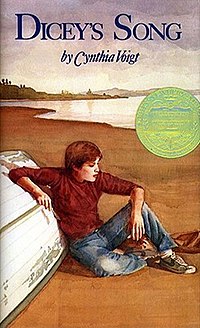
First, Dicey's Song by Cynthia Voigt. I listened to this one a loooooong time ago and.... I honestly was pretty neutral on it. It is the second book in the series about the Tillermans - following Homecoming. My assessment of Homecoming was that it was a darker and edgier Boxcar Children. Dicey's Song picks right up where the first left off with the Tillerman kids adjusting to life with their grandmother. It is much more introspective as Dicey tries to decide what to do next. She feels that they will be asked to leave soon and tries to prepare for that while struggling to make several school decisions for her two youngest siblings. Both the books I listened to from this series seemed to be bogged down. I liked the gist if the story, but there was far too much filler.


The Dark Frigate by Charles Hawes is, to my knowledge, the only author to receive the Newbery posthumously. He was well respected for his tales of adventure on the high seas, often being compared to R.L. Stevenson. Ummm... I'm not entirely sure what happened in this book. There were pirates, a trial, and an inn. I remember hearing this book, but apparently I wasn't listening, it was simply too boring for me to really care.


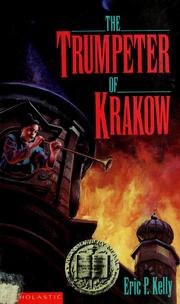
Finally, The Trumpeter of Krakow by Eric Kelly. I loved this book, in no small part I'm sure due to the fact that I was in Krakow when I listened to it!!!! Being able to see areas described in this book was absolutely thrilling. I started the audio book on the train leaving Bratislava (which was totally the wrong train but that story is for a different time and place) and finished it halfway through my visit. Krakow was probably my favorite city in Europe (neck in neck with Salzburg) and the old town is put on brilliant display in this book.

I totally believed that there had been a trumpeter in Krakow during the past ages - I never doubted that, but on my fist day visiting the Market Square I was delighted to hear the sounds of a trumpeter somewhere in the bustle. I came around a corner and saw glorious Saint Mary's tower where the sharp notes of music were coming from. From there I discovered the old town of Krakow both physically and through the text. Sometimes I went and found locations I had heard in the book first and sometimes I was surprised to hear the book mention a place I had visited just before. I've never experienced a book or new place in this way before and it was one of the highlights of my time in Europe! Now just for fun here are some pictures of locales mentioned in the book:

The mighty Vistula River, which features prominently in the very end of the book.

Florian's Gate, the only remaining piece of the walls that once surrounded the old town.

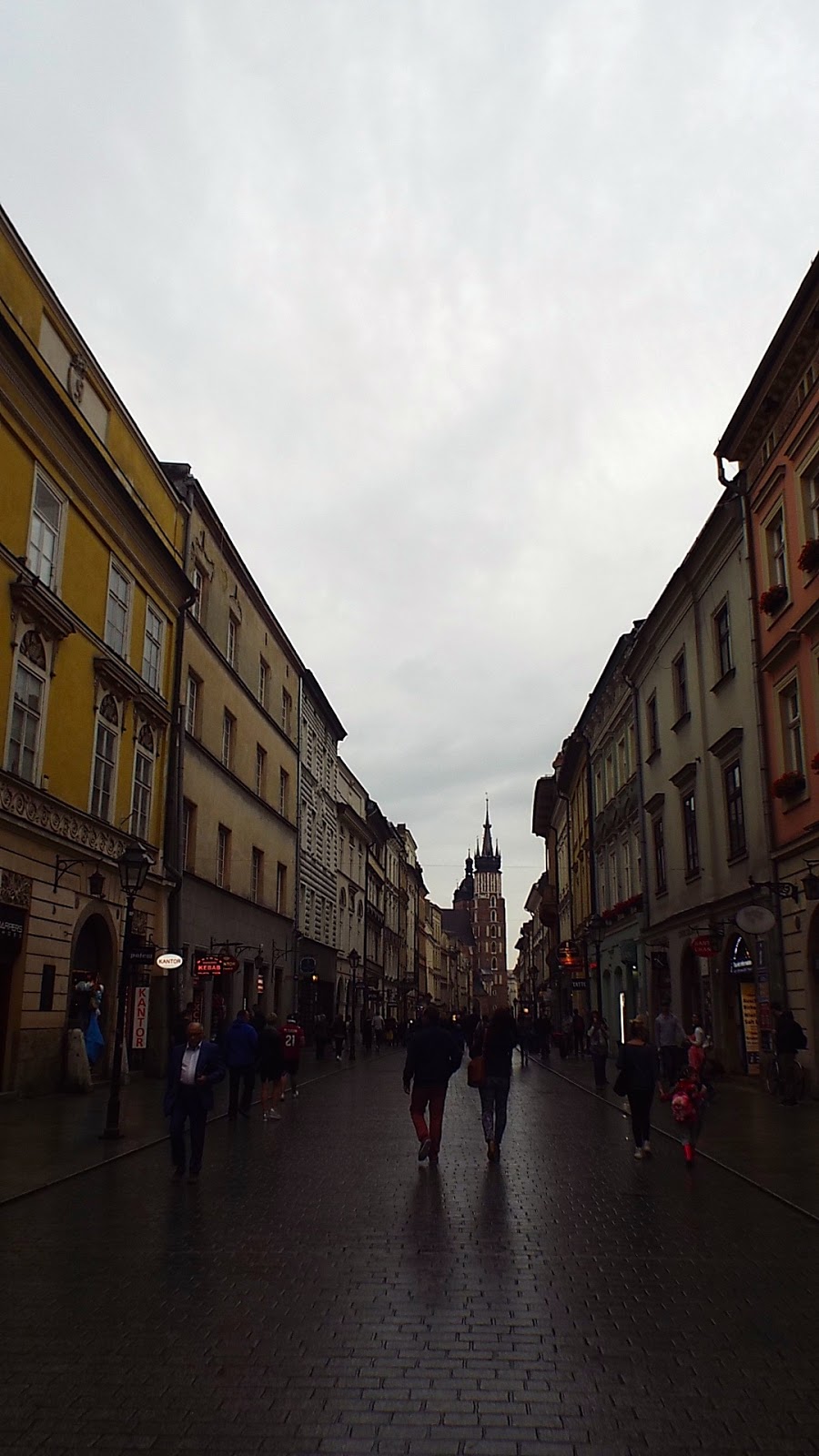
Street between Florian's Gate and the Market Square.

Cloth Hall, which houses a museum and arcade style shops.

View of the Market Square. The church on the right is Saint Mary's and the tallest spire is where the trumpeter plays from each hour. I waited several minutes one day to listen to him play out each window, it was so exciting!

Inside the oldest university building in Poland! The Collegium Maius was a key location in The Trumpeter of Krakow. It has seen famous students ranging from St. John Paul II to Copernicus.

The Wawel Cathedral, which is mentioned in the book but I don't recall it being of much importance.

Inside the Wawel Courtyard - looking back I see I don't have any spectacular photos of the Wawel, it is perched on a hill and all the buildings up there are so close together that getting a good shot was too difficult and I just enjoyed myself.

Another bit of the Wawel Cathedral.


Sunday, March 6, 2016

Amos Fortune: Free Man, Newbery Winner 1951


Amos Fortune: Free Man by Elizabeth Yates is a slim book. Actually, I've avoided it because it was the final entry on the only complete ranking of Newbery Winners that I was able to find a couple years ago (with only 90 entries you can see that it hasn't been updated).
To be fair, I'm a little conflicted on what to say about this book... Is it my least favorite? Far from it; reading the book was easy enough and I found the main character quite pleasant. But this is American history through decidedly rose colored lenses. While history has shown us that there were indeed men such as At-mun, whose name was changed to Amos Fortune I think that they were few and far between. And even those slaves which led decent lives were still slaves. This is a horror which is glancingly addressed in the text; this would not be an appropriate introduction to slavery for young pupils, lest they believe that being enslaved is more of a sad inconvenience than anything.
The years when Amos has paid for his freedom and that of four others are the most interesting parts of the book to read (and thankfully the bulk of the book) but even then the segregation he experienced is only passingly mentioned.
I don't think this is the worst Newbery. I don't even think it is a bad book. What it is a certainly a product of when it was written, a book that never ventures too far into the historical realities of slavery. Should children read this book? Perhaps, but only after they have seen the ugly, ugly side of slavery in America and have come to understand that just because someone (such as Amos) had a good life here, doesn't make that right.