Saturday, September 29, 2012
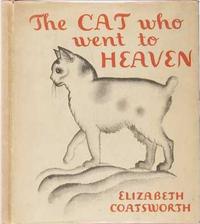
The Cat Who Went to Heaven, Newbery Winner 1931
This was a sweet, simple story. I am a cat person so the name of the story greatly appealed to me. I believe that children would enjoy this book, but an adult with some knowledge of Buddhism will need to be on standby. I really don't know more than basic tenures of Buddhism but I found the story easy enough to follow. It is a really short tale and there is no plot, but you come to really love the little cat, Good Fortune. It would be interesting to hear more of the old Buddhist folktales, they were new to me and I found it quite interesting to hear how there was a story about all the different animals in the painting. The ending was very satisfying, though some may find it sudden.
Saturday, September 8, 2012
Second Round-Up
Well, it's that time again! (Actually, it's past that time, I've read 11 books instead of 10!) Time for me to line 'em up against the wall. Order them, if you will. This was occasionally a difficult batch to get through, so difficult that I actually avoided a couple of books like the plague. There are some here I'm glad to tick off my list and there are some here that I can't wait to read again. Alright, from the top!
1. Crispin: Cross of Lead - This entry wins this section hands down. An amazing adventure story with great characters, not only the best award-winner I read this summer, but the best book period. I cannot wait to delve into the sequels and Avi's other works.
2. Caddie Woodlawn - Like Little House lite, this book is good old-fashioned fun. I'm always a sucker for good frontier literature though, giving this book a head-start on the list.
3. Kira-Kira - Without a doubt the most deeply emotional book of the lot, I enjoyed the simple, realistic and modern story. A was a refreshingly different sort of novel for me.
4. Good Masters! Sweet Ladies!: Voices from a Medieval Village: A wonderful collection of monologues. This is a literary style that is often overlooked, but I'm pleased that this collection was chosen, you get several little stories, plus one overarching tale of simple living.
5. Joyful Noise: Poems for Two Voices - That's right, I rated a book of bug poems higher than some of the 'great classics of children's literature'. This book is short, which kids like, and funny, which kids love.
6. Onion John - Oh Onion... You're too slow to absolutely love, but too good to hate! To the middle of the pack you'll have to go.
7. Missing May - A wonderful tale that explores the emotions surrounding grief. As a bonus I just figured out that the author also wrote one of my favorite picture books, The Dreamer.
8. A Visit to William Blake's Inn - Thinking over these poems for a couple of days helps nothing. The book is still trying to hard to be great. I do like the illustrations though, and a couple of the poems merit re-reading.
9. Johnny Tremain - Goodness, I hated this book. It took all my will power to sit down and finish it. It commits the crime of ruining what should be a good story. I'll never know how Forbes did it, but somehow she made the American Revolution boring. Only gets this high on the list for managing to stay in print, which brings us to...
10. Dobry - For a book in which absolutely nothing occurs (and takes its own sweet time doing it) the only bright spot was that it was set in Eastern Europe and we got a Christmas chapter.
11. Daniel Boone - Forget the crime of offensiveness, few will ever make it that far in the book. It was like wading through mud to retrieve a bucket of dirt. Ultimately, you saw no reason to continue. The only reason I finished is because I'm stubborn (save one page that had been removed by library, parent, or reader for which I'm am grateful to them for shortening the book).
There, I know it is difficult seeing Missing May next to William Blake but I strenuously apologize. A countdown from the beginning!
1. Number the Stars
2. Crispin: Cross of Lead
3. Julie of the Wolves
4. Bud, Not Buddy
5. King of the Wind
6. Out of the Dust
7. Caddie Woodlawn
8. Kira-Kira
9. Sounder
10. Good Masters! Sweet Ladies!: Voices from a Medieval Village
11. Bridge to Terabithia
12. Sarah, Plain and Tall
13. Joyful Noise: Poems for Two Voices
14. Call It Courage
15. Onion John
16. Missing May
17. The Whipping Boy
18. A Visit to William Blake's Inn
19. Johnny Tremain
20. Dobry
21. Daniel Boone
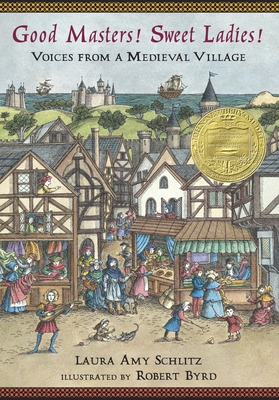
Good Masters! Sweet Ladies!: Voices from a Midieval Village, Newbery Winner 2008
I'd been led to believe that this book would be a real snore by the stories citing it as an example that the Newbery committee was out of touch and choosing books that children would never read. For what it is worth I loved it. This book lets you take a highly personal look at several children. None are incidental, I also found them to be telling a larger story that spans a long period of time. I always found it interesting when one monologue would refer back to another. There were also several stories where I would like to know what eventually happened, but, alas, I cannot. Perhaps for the best, since undoubtedly the hopes and dreams of the lower class would never be fulfilled, such was life for them.
Each monologue is written in a slightly different style, giving a wide variety of tastes something to chose from. I think that this would be a fun work to use in a classroom, like Shakespeare for the younger crowd. In any case, I'm sure that many readers will like the short 'story' format offered by each monologue, and there is something here for everyone romance, action, thievery, kindness, and more!
Tuesday, September 4, 2012
Joyful Noise: Poems for Two Voices, Newbery Winner 1989
The committee in the 80s must have loved poetry! All I can say is that, as skeptical as I was regarding this book (every poem is about bugs?), I found it to be immensely enjoyable.
I stumbled through the first poem several times, it is almost impossible to read poems for two voices by yourself I discovered. If you are also struggling with these poems I assure you they really are beautiful. Paul Fleischman has even managed to make me care about a wasp, an animal I never thought of as remotely emotional. The secret is sound, these poems must be heard to be enjoyed, you can't just read them yourself, there must be another.
Watch this video to hear for yourself, even though the poems are in a different order than the book.
Amazing, isn't it? You just listened to poetry about bugs. I enjoyed this so much more than William Blake's Inn. It was far more aware, and dare I say, emotional. Emotion is the foundation of poetry, something that really came through in this collection. I was pleased to have such a wonderful book to pass the minutes away with, it seems I've been in a bit of a rut with the books being outside of my interest range.
A Visit to William Blake's Inn, Newbery Winner 1982
Ummm... Well it was short. I don't know, when I think of poetry for children this isn't what really comes to mind. There is more than the usual amount of deep thinking that might be associated with a picture book. That isn't to say that I think all kids' poetry should be rhymed couplets with fanciful drawings, actually my favorite children's poets are Stevenson and Kipling.
Tuesday, August 7, 2012
Johnny Tremain, Newbery Winner 1944
Well...
I was told this was a boring book. I've spent nearly ten years using it to mock my brother. But until now I didn't truly know just what this book had in store for me. Should there be any doubt as to my feelings about this book you only need to check the dates between this review and the last one. About 2/3rds of the way through the book I ran out of steam and kept putting it off for later. I'm finally done, and only because of an impending due date at the library.
In theory it should have been a great book for me. I love historical fiction and I'm positively obsessed with the American Revolution. Take this one sentence summery: A horrible accident befalls a young silversmith, forcing him to leave his trade; however Johnny Tremain soon finds himself entwined with the events leading to the American Revolution and the founding of a new country. Doesn't that sound awesome? To me it did but I was so disappointed. The writing was good, the story itself was exciting, but somewhere, something, was wrong. I've thought and thought about went wrong and as near as I can tell there isn't actually anything bad about the book but... I just didn't care. Maybe the descriptions just bogged me down; any one description by itself is fantastic and detailed, all together there is just too much.
At least I have lots of other great sources for the American Revolution that I can use instead.
Sunday, July 22, 2012
Kira-Kira, Newbery Winner 2005
Let me say first off that I absolutely loved this book. And it was very sad, probably the saddest one I've read so far. (Although I didn't technically read it, I listened to it on my car trip.)
In high school I took a keen interest in Japanese-Americans during WWII and this book played into that interest. It is set in the 50s and 60s and is about the relationship of two sisters. They face prejudice and hardship in their new home in Georgia, but they also face a devastating illness.
One of the things I enjoyed most about this book was the characters. Some reviews I've read say that the characters are flat, but I disagree. The characters aren't flat, they also aren't over the top. Each has their own past, suitable development, and fun traits.As for the relationship between Katie and Lynn, I feel it is developed perfectly. I also believe that the reactions Katie has throughout the book to different things are believable.
I did however, struggle with how appropriate this book was for children. I mean it has breasts, kissing, sperm (the word, during Scrabble), violence, prejudice, death, and swearing. I kept a tally in my head, thinking 'oh my!' every time something popped up. The problem being that I was judging them as an adult judges works for children. When I stepped back and tried to view it from a child's perspective I knew that children are waaaaaaaaaaaaay more interested in the overall picture than in nuances. (I watch old movies now and get far more of the jokes.) The only items on that list that kids will remember as important are prejudice and death. And really, that's not so bad. So I eagerly welcome the addition of Kira-Kira to my classroom collection.
In high school I took a keen interest in Japanese-Americans during WWII and this book played into that interest. It is set in the 50s and 60s and is about the relationship of two sisters. They face prejudice and hardship in their new home in Georgia, but they also face a devastating illness.
One of the things I enjoyed most about this book was the characters. Some reviews I've read say that the characters are flat, but I disagree. The characters aren't flat, they also aren't over the top. Each has their own past, suitable development, and fun traits.As for the relationship between Katie and Lynn, I feel it is developed perfectly. I also believe that the reactions Katie has throughout the book to different things are believable.
I did however, struggle with how appropriate this book was for children. I mean it has breasts, kissing, sperm (the word, during Scrabble), violence, prejudice, death, and swearing. I kept a tally in my head, thinking 'oh my!' every time something popped up. The problem being that I was judging them as an adult judges works for children. When I stepped back and tried to view it from a child's perspective I knew that children are waaaaaaaaaaaaay more interested in the overall picture than in nuances. (I watch old movies now and get far more of the jokes.) The only items on that list that kids will remember as important are prejudice and death. And really, that's not so bad. So I eagerly welcome the addition of Kira-Kira to my classroom collection.
Subscribe to:
Comments (Atom)