Monday, June 29, 2020

Smoky the Cowhorse, Newbery Winner 1927


It's official - just because Marguerite Henry can write a Newbery winning horse book that becomes one of my favorites doesn't mean everyone can. I'm saying it right now - unless you're reading all the Newbery books I do not recommend this book and I especially do not recommend for children.
Where to start?

The book starts off nice enough - if slow. We follow the adventures of young Smoky in the mountains  - presumably the Rocky Mountains (Wyoming was mentioned but I'm not sure if that was where the Rocking R lands were or not). Anyhow happy horsey antics make up the first 80 pages. Like I said this part was nice - if we just had the life of a wild horse for 200 or so pages it would have been a  solid enough story. Heavy on the dialect, and poeticism - but solid.

Now - the middle piece. Uggggggh. The next 120 pages could have been condensed sooooooo much. Basically it is how Clint, a bronc buster, broke Smoky and became his rider. Smoky only liked Clint and he was a mighty fine horse. They ride the range for a few years until Smoky attains legendary status. It took me for-ev-er to get through this part. In the end I bought the Kindle book and used some fancy feature I've never needed before that drug the words across the screen, meaning I had to keep going or get lost. This chunk of the book contained important set-up but very little in the way of interesting plot.

So by this point in the book you would honestly have been better off choosing almost any other horse book that I'm familiar with and probably a fair number that I'm not familiar with. If you want the story of the West from the horse's mouth there's also this old animated movie - which I dug, it gives you a pretty similar plot sans the ending.


Alright, there are 120 pages left. What could they possibly bring us? Well, two things really: the plot and... racism.

Let's be honest the Newbery - and children's literature in general is no stranger to racism. It pops up all the time in things this old. The scale also ranges dramatically - not that it is ever right, but some offenses are definitely more egregious than others. I have read almost 90% of the Newbery winners now and this one was the one that made me think less, "Wow, this was written in a different era." and more, "Yikes."

This is gonna take an entire post in the future, but for now here are some choice quotes from the book - a book marketed to Ages 8-12 according to my copy printed in 2008 or later.

"All of him, from the toe of his gunny sack covered boots to the dark face which showed under the wore out black hat, pointed out as the man being a half-breed of Mexican and other blood that's darker, and noticing the cheap, wore-out saddle, the ragged saddle-blanket on a horse that should of had some chance to feed instead of being tied up, showed that he was a halfbreed from the bad side, not caring, and with no pride." (219-20)

We get many more instances referring to "his kind", "half-breed", and "the breed".

"There was all about the horse to show that he'd been right in his first dislike for the dark faced hombre." (240)

"But there was one thing which the riders noticed in him as most queer, and that was in the way he seemed to hate some humans worse than others - his hate was plainest for the face that showed dark." (251)

"'Say, cowboy,' (the sheriff) finally says, 'don't scatter that hombre's remains too much, you know we got keep record of that kind the same as if it was a white man, and I don't want to be looking all over the streets to find out who he was.'" (315)

Can anyone in good faith give this to an 8 year old? I hope not. Again, I've got a dedicated post planned, but it's going to require some planning and research.

For the record Will James was surprised he won the Newbery since Smoky was published for adults... my future blog plans include comparing the Newbery winners to honors and choosing the book I believe was the best. The honor books for 1927 are - lost to time or never existed. Was this adult book really the best for the year???
Some internet sleuthing later...

I turned up two other contenders on Wikipedia (my sleuthing isn't very comprehensive today) - Doctor Dolittle's Caravan by Hugh Lofting and The Hungry Tiger of Oz by Ruth Plumly Thompson. I haven't read either of these yet, but I can imagine the Lofting would have taken the prize had it not been for the tiny detail that he'd won four years previous. If anyone can name a 1926 American children's book that deserved the win let me in on the secret please!

Sunday, June 28, 2020

The Higher Power of Lucky, Newbery Winner 2007


Going into this book I only knew two things about it: it won a Newbery and it contained the word scrotum... yeah, moving along. Not gonna lie about that second bit - I have no idea why Susan Patron thought this was necessary because it has absolutely no bearing on the plot whatsoever. But, as the old saying goes, this is your train - rob it.

Except she was robbing it for literature and not science.

I really enjoyed the book for the most part. It examines family in a different and interesting way - Lucky is being raised by her father's first ex-wife, a French woman named Brigitte. Her father has no role in either the book or her life and her mother is mentioned only to recount her death, funeral, and Lucky's inability to part with her ashes. I think that Lucky and Brigitte share an incredible dynamic - both loving each other but Lucky showing a believable amount of trepidation.

We are also given a glimpse of life in a tiny, tiny town. Everyone knows each other. For the most part they support each other. Some things simply don't exist in town and some really crazy things do. Living in a small town the last several years (not as small as in the book), I can relate to a lot of these things.

The important theme of family and how it isn't just the textbook definition are carried through to all the primary characters of the novel and the predictable (kind of sappy) ending is just the one you want.

Wednesday, June 17, 2020

A Year Down Yonder, Newbery Winner 2001


This was such an odd little book. It reminded me of a much older book - in fact, let's call this Up a Road Slowly: The Good Version. That's probably stretching it quite a lot but there you have it. This book reads as being written much earlier than it really was, which is appropriate since it is set in the 30's.

A Year Down Yonder returns the protagonist Mary Alice to her grandmother's small community... Returns? Wait a moment....


I have once again failed to read all books leading up to the winner. I can say that it doesn't affect the reading of this book in any way. The characters and setting were totally fleshed out and the only hint that I missed a book was a quick sentence Mary Alice said referring to time she had spent with her grandmother and her older brother. It wasn't said in a manner that was just background, I was expected to reflect and say, "Ah, good times."

Still the characters in this story rang true to their time. Grandma Dowdel was hilarious and slightly rebellious in a way only the elderly can be; she reminded me of the elderly Miss Volker (Dead End in Norvelt).  Mary Alice is a girl that perhaps another author would have wanted to make a tomboy. She isn't overtly 'feminine' but she is also an ordinary girl - not forced into any trope one way or the other. 

This book isn't very plot-driven, rather it is a series of vignettes. Another way it harkens back - I often find older books to be less plot heavy than modern literature. It was really relaxing and enjoyable because of this - sometimes all you need is a series of events loosely tied together by enjoyable characters.

Sunday, June 14, 2020

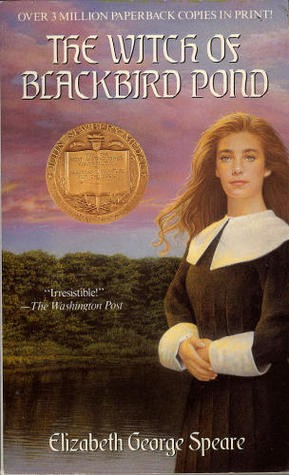
The Witch of Blackbird Pond, Newbery Winner 1959


This was assigned reading when I was in 6th grade. I didn't read it very thoroughly but I got the gist. Well, here I am for a complete reading and I must say - I found it enjoyable.
in the 1600s Katherine (Kit) grew up living a fairly privileged life in Barbados. When her grandfather dies she heads north to her only remaining family in Puritan New England.

These are hilarious and I didn't really have anywhere else to share them.

As one would expect she causes a stir but her aunt and uncle allow her to move in with them and her two cousins. She quickly catches the eye if a local boy and he commences to courting her. She also makes friends with a young girl with an extremely strict mother and a widow living alone in the swamp. This widow is Hannah, a Quaker who does not join worship services with the Puritan community.

Kit tries her best to fit in but has trouble adjusting to the stricter laws and practices of the Puritans. She is especially uneasy about the fact that the man courting her is building a house when she doesn't think she really wants to marry him.

When a horrible sickness strikes the community a mob forms to drive out 'the witch of Blackbird Pond' (Hannah) and Kit rushes to her aid, arriving just in time. Now that Hannah has been saved Kit finds herself the subject of suspicion and must decide how to protect herself and her family.

Overall a decent read with good history and interesting conflict. I would have like to see the characters beyond Kit fleshed out a little more - but in such a short book I understand.

Sunday, May 10, 2020

I, Juan de Pareja; Newbery Winner 1966


I remember having to read this book at some point during middle school and not really reading it - because I was an awful student that never wanted to read assigned books. However, I also remember becoming interested in the artists we talked about in class. I still recall my fascination with Diego Velázquez and his dedication to realism and an interesting use of mirrors. We also had to do a creative writing project taking two paintings and writing a short story to explain them.

I can't be 100% certain, but this may have been one of my selections.
A Woman Seated at a Table Cutting a Slice of Cheese by Esaias Boursse

I mentioned before that Veláquez was fiercely devoted to realism in his paintings, or, as he called it, the truth. He strove to show things as they really were instead of prettying them up, as was the fashion of the time. Which brings us this portrait.
Yes, Juan de Pareja was a real person. As is true of many persons from so long ago only a bare outline of his life is known - but this portrait is so raw and detailed that we practically have a photograph of our subject that can shed some light. Elizabeth Borton de Treviño took what little was known and spun a historical narrative around it. Juan de Pareja was a slave that was inherited by Diego Velázquez and served him both at home and while traveling. Despite laws forbidding slaves from practicing the fine arts, Juan observes his master and learns to paint. Part of me loves the friendship between the two artists but another part of me is keenly aware that only basic lip service is given to the fact that Juan is a slave. His happiness can be uncomfortable - do I begrudge any person, even those in dire straits, happiness? Of course not, but it feels somehow disingenuous. We do know that Diego freed Juan and Juan continued to work for him - so there was obviously some level of admiration there, whether as friends or professionals we may never know. The author's note sheds a little light, her idealism stems from her hopes for the Civil Rights Movement. Overall, I'd recommend for anyone interested in art and most people interested in history.

Wednesday, May 6, 2020

The Eighth Round-Up


Coming down the home stretch! I’ve now read and reviews 80% of the Newbery winners!!! Considering how long I have put off some of these books they weren’t too bad! Only two of them were so boring I’d not consider reading them again.

1. Merci Suárez Changes Gears – I loved this book sooooo much! I truly believe that it is the most timeless story from the last decade – in a decade already filled with timeless tales! Part of my fondness is undoubtedly how much I connect with Merci, she is definitely one of those mirror characters.

2. Roll of Thunder, Hear My Cry – A classic for a reason! I can see why this is one of those books that anyone who cares about children’s literature makes time to read. I can’t wait to dog into more of this author’s work!

3. Moon Over Manifest – A great story told through a series of flashbacks. I really like these kinds of stories where the past and the present tie together, it seems to happen more in movies and tv shows (where you can – bonus! – use the same actor in multiple roles), so it was nice to see it in a book format.

4 New Kid – Finally, the graphic novel is coming into its own! This was a nice story filled with lots of layers and nuances. I wouldn’t hesitate to recommend this to any m9ddle schooler.

5. Hello, Universe – Lovely story with a wide range of believable characters, gives us one of the most interesting looks at the bullied and the bully in modern kid’s lit.

6. Dead End in Norvelt – So quirky and funny, I enjoyed this tale of small town America and how this community functions.

7. Jacob Have I Loved – So much better than I expected, Katherine Paterson somehow makes a whiny protagonist pining after an old man work.

8. The Slave Dancer – Not too shabby as far as 70s historical fiction goes – but I wanted it to get more in depth. However that would have taken the book out of the target age range.

9. Criss Cross – Middle school angst. Bleh.

10. Rifles for Watie – Zzzzzzzz…

And now, the countdown!

1.             A Wrinkle in Time
2.             Number the Stars
3.             Crispin: Cross of Lead
4.             Island of the Blue Dolphins
5.             Julie of the Wolves
6.             Maniac Magee 
7.             Bud, Not Buddy
8.             King of the Wind
9.             The Trumpeter of Krakow
10.          Out of the Dust
11.          When You Reach Me
12.          Crossover
13.          Merci Suárez Changes Gears
14.          The Tale of Despereaux
15.          The Door in the Wall
16.          Holes
17.          Caddie Woodlawn
18.          Kira-Kira
19.          Sounder
20.          Good Masters! Sweet Ladies!: Voices from a Medieval Village
21.          The Giver
22.          The Westing Game
23.          Bridge to Terabithia
24.          Roll of Thunder, Hear My Cry
25.          The View from Saturday
26.          Sarah, Plain and Tall
27.          Joyful Noise: Poems for Two Voices
28.          Call It Courage
29.          Miracles on Maple Hill
30.          Moon Over Manifest
31.          The Wheel on the School
32.          The Cat Who Went to Heaven
33.          The One and Only Ivan
34.          The Midwife's Apprentice
35.          Mrs. Frisby and the Rats of NIMH
36.          The Twenty-One Balloons
37.          The Hero and the Crown
38.          Onion John
39.          Shiloh
40.          The Graveyard Book
41.          New Kid
42.          Adam of the Road
43.          The Girl Who Drank the Moon
44.          Hello, Universe
45.          The Summer of the Swans
46.          Dear Mr. Henshaw
47.          Missing May
48.          Dead End in Norvelt
49.          Tales from Silver Lands
50.          Last Stop on Market Street
51.          Voyages of Doctor Dolittle
52.          Jacob Have I Loved
53.          A Gathering of Days
54.          The Whipping Boy
55.          The Slave Dancer
56.          Dicey's Song
57.          Shen of the Sea
58.          Shadow of a Bull
59.          The White Stag
60.          Rabbit Hill
61.          Strawberry Girl
62.          Flora and Ulysses
63.          Miss Hickory
64.          The Matchlock Gun
65.          A Visit to William Blake's Inn
66.          Thimble Summer
67.          M.C. Higgins, the Great
68.          Young Fu of the Upper Yangtze
69.          It's Like This, Cat
70.          Ginger Pye
71.          The Secret of the Andes
72.          Criss Cross
73.          Up a Road Slowly
74.          The Dark Frigate
75.          Rifles for Watie
76.          Amos Fortune, Free Man
77.          The Story of Mankind
78.          Johnny Tremain
79.          Dobry
80.          Daniel Boone

Jacob Have I Loved, Newbery Winner 1981


We have a repeat author! Katherine Paterson also wrote Bridge to Terebithia which won in 1978. I'm kicking things into high gear, not only is the end nearer than ever before - but next year's winner will be the 100th Newbery book!

And we're off!

First off - this book is one that I had been putting off based solely on the title and cover art. So... melancholy. 


And those taglines??? So dramatic.

First, let's address that title. There is not a love interest named Jacob in this book that the sisters end up fighting over. It refers to a Biblical quote:
This one.

Jacob and Esau were twins - one of whom was clearly favored by God. The twins in this book are Sara Louise and Caroline Bradshaw- and I'm sorry but the rivalry was really one-sided, to the point that I couldn't even sympathize with the narrator, Sara Louise, most of the time. She goes on and on about how selfish and awful her sister is but really only once did Caroline do something even a little despicable. She also complains that her family doesn't love her as much - but I see a family that is trying their best to give their daughters what they deserve. Sara Louise is so jealous of her sister that SHE ends up hating and pushing others away from her. No one is pushing her away as this whole "Esau have I hated business would imply". I concede that her grandmother is kind of a jerk to her - but she is clearly beginning to suffer mentally and the rest of the family pays no mind to what she says. 

So yeah. I didn't care for the protagonist. But that is just the beginning. An old captain named Hiram returns to the island and becomes friends with Sara Louise and a boy named Call. During a hurricane Hiram stays with the Bradshaw family, later he and Sara Louise go to check his property only to discover it is completely gone. She gives him a hug and experiences a sexual awakening.


Sooooooooooo...... she spends a good chunk of the novel pining for Hiram - even while acknowledging that she is, at 14, too young for him. She refuses to visit him after he enters a marriage of convenience with a stroke patient. During this time Caroline and Call continue to visit the captain and his wife and become great friends. Later, the captain uses his inheritance to send Caroline to a conservatory to expand her amazing gifts as a singer. Call goes to war and Sara Louise remains on the island stubbornly refusing her parent's offer to attempt to enroll her in a mainland boarding school. She spends the next several years pining for the captain. Even as we learn that her grandmother also pined for him... but was too young and he left for college while she was still a young girl.

That's... massively uncomfortable.

But, in spite of not caring for the protagonist and being slightly skeeved out by the young girl desperate for the romantic affection of a 70+ year old man.... I liked the book. Why on earth do I still like it after all that? I guess that Katherine Paterson is just that good.